Diesel holds water in three states: dissolved (invisible, in solution), emulsified (fine suspended droplets) and free (a separate bottom layer). Free water is drained or separated, emulsified water is captured by coalescing or hydrophobic membrane separation, and dissolved water can only be managed by keeping fuel dry enough that it stays dissolved - mechanical filters do not remove it.
Where the water comes from
Storage tanks breathe. As temperature swings between day and night, the tank draws in humid air and releases dry air; moisture condenses on the cooler tank walls and roof and migrates downward. Delivery fuel adds its own contribution, since road tankers can hand over water and disturbed bottoms from previous loads. Biodiesel blends compound the problem: ester fuels are more hygroscopic than conventional diesel, so they hold more dissolved water and release it as free water as temperature drops.
The three states, and what each one does
| State | Where it is | How to detect it | What it causes |
|---|---|---|---|
| Dissolved | Chemically in solution within the fuel; invisible | Laboratory titration (Karl Fischer) | Generally harmless while dissolved - but it is the reservoir that feeds the other two states |
| Emulsified | Micro-droplets suspended in the fuel, often after pumping or agitation | Hazy or cloudy fuel sample | Reduced lubricity, injector wear, carry-over into combustion |
| Free | Separate layer at the tank bottom | Bottom sample, water-finding paste, crackle test | Tank corrosion, microbial growth, sudden slug ingestion |
The crackle test is the standard field check: a drop of fuel on a hot plate crackles or pops if free or emulsified water is present. It is qualitative - it tells you water is there, not how much. Laboratory titration quantifies total water.
Why ISO 4406 particle counts will not show it
ISO 4406 cleanliness codes count solid particles - they say nothing about water. A tank can show an excellent particle code while harboring a growing free-water layer. Water and particles need separate monitoring and separate removal capability. This is also why automatic particle counters calibrated per ISO standards can misreport when free water droplets are present: droplets are counted as if they were particles. Cleanliness and dryness are two different targets.
Removal methods, matched to the state
Free water: settle, drain, separate
Free water is the easiest to catch and the most damaging if missed. Tank bottom drains remove the accumulated layer, but only when drained on schedule - a drain nobody opens is a layer nobody stops. In a polishing loop, suction from the tank's lowest point captures free water together with the sludge it feeds, and separation equipment strips it out before the fuel returns.
Emulsified water: coalescing or hydrophobic separation
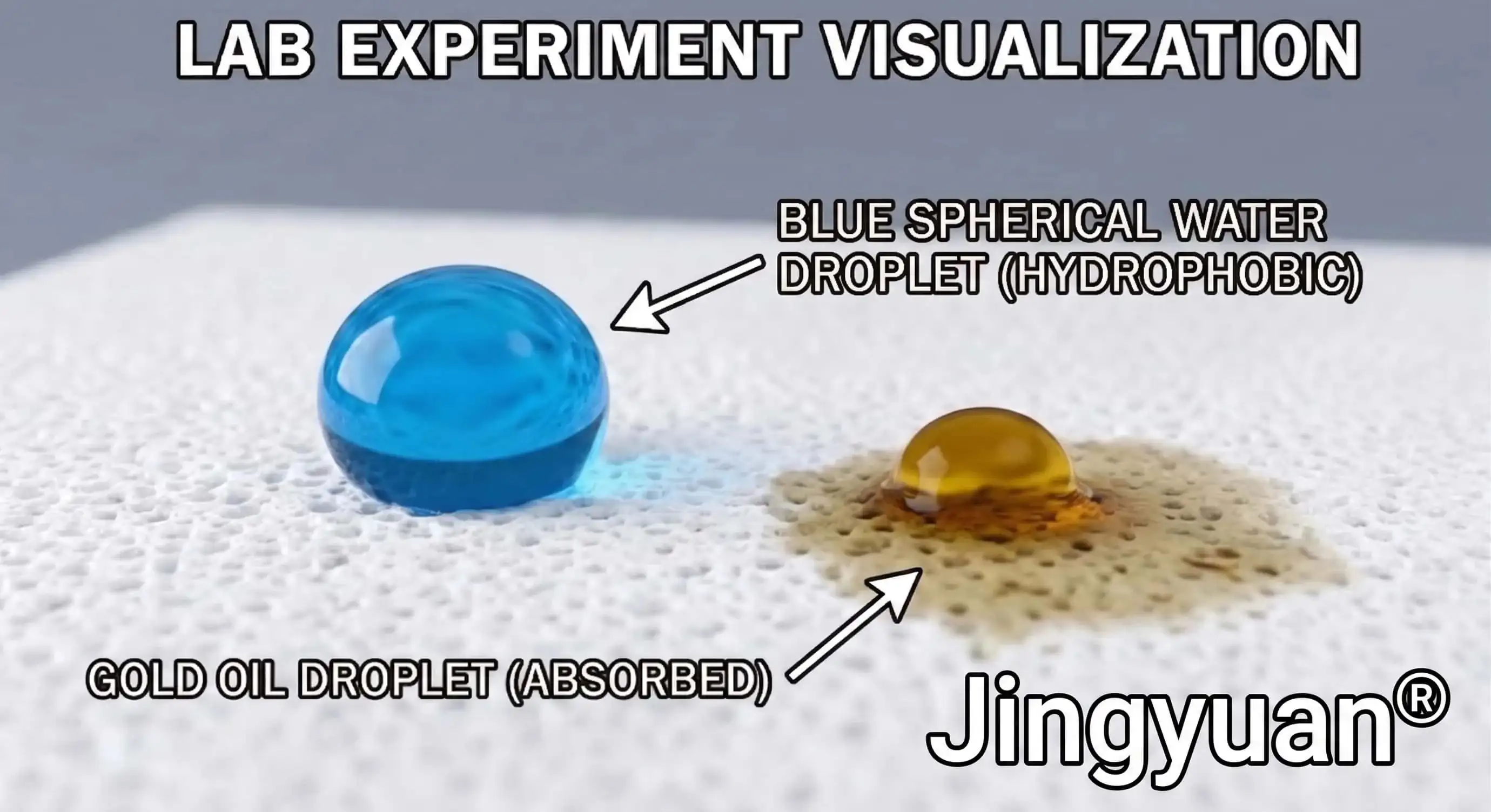
Emulsified droplets are too small and too dispersed to settle quickly. Two mechanical approaches exist. Coalescers merge droplets into larger ones that fall out by gravity - but they are sensitive to surfactants, biodiesel surface-tension effects, microbial byproducts and cold fuel, which is why coalescer performance degrades silently in many modern fuels (the five classic failure modes are documented here). Hydrophobic membrane separation takes the opposite approach: the membrane passes fuel and physically repels water, capturing droplets without chemical additives and without relying on droplet growth.
Dissolved water: manage, don't chase
No mechanical filter removes dissolved water - it is not a particle. The practical strategy is containment: keep the tank dry enough that dissolved content stays in solution, and remove the water as soon as it exits solution. Continuous polishing does exactly this, which is why polished systems hold free water at very low levels - on Jingyuan systems, ≤ 50 ppm free water - rather than attempting to strip dissolved moisture chemically.
Application scenarios
- Standby generator tanks — low draw, heavy condensation cycle; free water is the reliability killer. See the data center fuel polishing guide.
- Gas station and fleet tanks — frequent delivery agitation emulsifies water already present; dehydration at transfer protects dispensers.
- Biodiesel blend storage — higher dissolved-water load makes continuous separation more valuable, not less.
Buying considerations
- Ask how the system handles each state. A particle-only filter is not a water remover. Look for a stated free-water outcome (e.g. ≤ 50 ppm) and the mechanism behind it.
- Prefer additive-free separation. Demulsifier dosing adds a chemical supply chain and alters fuel properties; hydrophobic separation is physical.
- Check temperature and fuel compatibility. The separation method must hold performance with biodiesel blends and cold fuel, not just neat diesel at room temperature.
- Consider regeneration. Water-laden media that must be replaced creates recurring cost; regenerable rigid membranes (gas-pulse backwash) avoid it - see gas-pulse regeneration.
Frequently Asked Questions
Can a fine filter remove dissolved water from diesel?
No. Dissolved water is part of the fuel solution, in single-molecule form. Mechanical filtration - however fine - captures particles, not molecules dissolved in the fuel. Dissolved water only becomes removable when it comes out of solution as emulsified droplets or free water, which separation equipment can then capture.
What is the crackle test for water in diesel?
The crackle test is a qualitative field check: a drop of fuel is heated on a hot plate. If free or emulsified water is present, it flashes to steam and audibly crackles or pops. It detects free water quickly but does not quantify it - laboratory titration is used for measurement.
Why does water in diesel cause microbial growth?
Bacteria and fungi colonize the interface between the fuel and any free water at the tank bottom, using the hydrocarbons in the fuel as food and the water phase as habitat. Removing free water removes the habitat; without a water phase, microbial growth cannot sustain itself.
Related Articles
Related Products, Technology & Applications
JY-DX5 Compact Skid
5 m³/h with room-temperature diesel dehydration, 2–15 μm capture.
ProductJY-DX40 Skid-Mounted System
40 m³/h fine filtration with water separation for tank farms.
TechnologyWhy Coalescers Fail
Five failure modes that disable coalescing in modern fuels.
TechnologyGas-Pulse Regeneration
Membrane backwash with a brief controlled safety shutdown.
TechnologyDiesel Stability & Storage Life
How moisture migration drives degradation chemistry.
ApplicationsIndustry Solutions
Case studies by industry: depots, mining, data centers, fleets.