Diesel fuel polishing is the continuous recirculation of stored diesel through a bypass filtration loop that removes particles, free water and microbial debris. A tank needs polishing when fuel sits still for months - typically from six months onward degradation accelerates - or when tests show rising particle counts, free water or microbial growth.
Why stored diesel degrades at all
Diesel is not chemically inert in storage. Industry experience and fuel-stability research consistently show that noticeable degradation begins within months of static storage, with a commonly cited window of 6–12 months before quality loss becomes operationally significant. Three mechanisms run in parallel:
- Oxidation and polymerization — oxygen, heat and dissolved metals form gums and insoluble particulates that darken the fuel and load the filter.
- Water accumulation — condensation from tank breathing introduces free water, which settles at the tank bottom.
- Microbial growth — bacteria and fungi live at the fuel-water interface, producing biomass, sludge and corrosive acids.
None of these processes reverse on their own. A tank left untreated does not recover; it accumulates a bottom layer of sludge and water that is drawn into transfer lines whenever level or temperature changes stir the tank.
What fuel polishing actually does
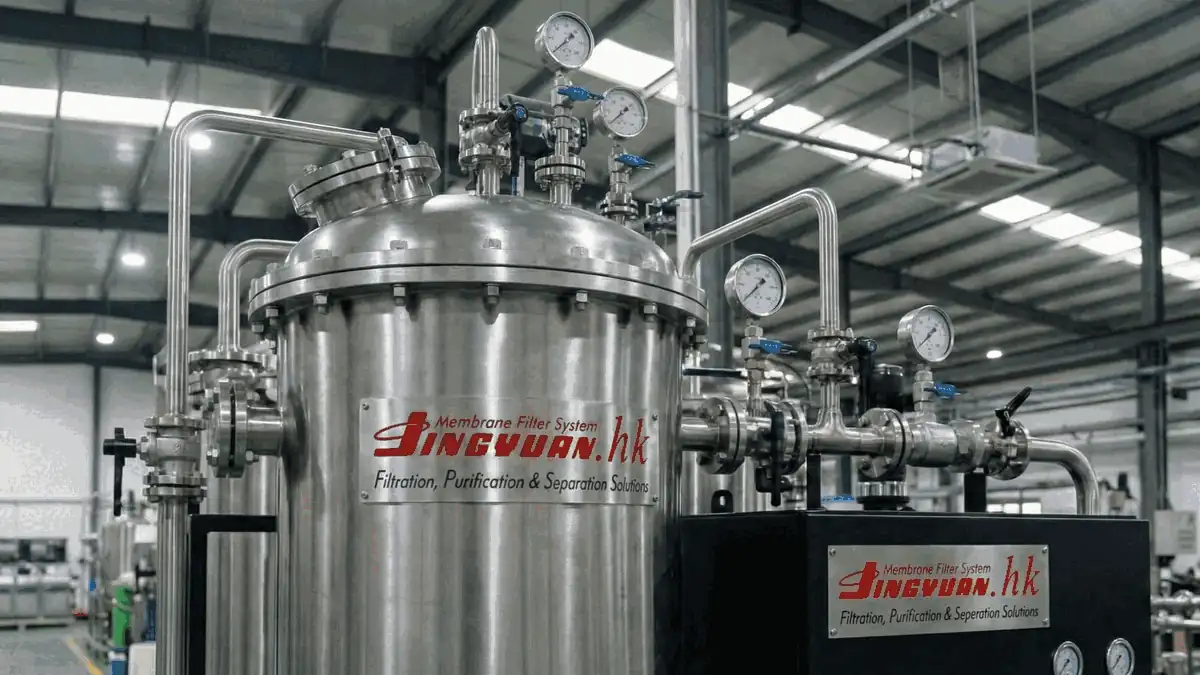
A fuel polishing system operates as a kidney loop: an independent circuit that continuously draws fuel from the lowest point of the tank, passes it through fine filtration and water separation, and returns clean fuel to the tank top. It runs in parallel with the engine supply line - the engine draws fuel exactly as before.
A typical pass performs three jobs:
- Particle capture. Rigid composite membrane elements provide a high filtration ratio - on Jingyuan systems, β ≥ 200 per ISO 16889 at the rated size, meaning a single pass retains at least 99.5% of particles above the rating.
- Water separation. Hydrophobic membrane phase separation removes free water physically, without demulsifier chemicals; on Jingyuan systems free water is controlled to ≤ 50 ppm.
- Debris removal. Microbial biomass and tank-bottom sludge fragments are captured with the particulate load instead of being left to grow at the fuel-water interface.
Because the loop recirculates continuously, contamination falls progressively with every pass - the opposite of a one-shot service visit, after which degradation simply restarts.
Key parameters to understand before comparing systems
| Parameter | What it means | Typical reference point |
|---|---|---|
| Filtration ratio β (ISO 16889) | Particles upstream vs downstream at the rated size | β ≥ 200 = ≥ 99.5% single-pass capture |
| Cleanliness (ISO 4406) | Particle count code per mL at ≥4 / ≥6 / ≥14 μm | 18/16/13 is the widely referenced supply limit for diesel engines; many operators target stricter levels such as 14/12/9 for storage polishing |
| Free water | Separate water phase in the tank or fuel | ≤ 50 ppm is a common target for polished fuel |
| Regeneration | How the media is cleaned instead of replaced | Gas-pulse backwash with a brief controlled safety shutdown (typically 5–15 minutes) and ≥ 90% flux recovery |
Injector clearances in modern high-pressure common-rail (HPCR) systems are in the 2–5 μm range, which is why particle control matters long before filters visibly clog: contamination causes wear, not just blockage.
Warning signs a tank needs polishing
- Fuel has been stored 6 months or longer without treatment.
- Standing water or dark sludge is visible at tank-bottom sample points.
- Engine fuel filters clog noticeably faster than expected.
- Laboratory tests show rising particle counts, microbial growth, or free water.
- The tank feeds standby or emergency equipment that must start on demand.
The last point deserves emphasis: standby generators and emergency fleets burn little fuel, so their tanks age in place. Fuel polishing exists precisely for fuel that is stored but must be reliable.
Application scenarios
- Oil depots and fuel farms — high turnover tanks where incoming fuel quality must be protected and maintained. See sizing by tank volume and turnover.
- Data center and hospital standby generators — long-dwell storage with a hard reliability requirement.
- Mining and construction fleets — mobile refueling in dusty environments, where injectors are the highest-value consumable. See the mining fuel polishing guide.
- Gas station and fleet tanks — dispensing quality is part of the customer experience.
Field results for these scenarios are documented in the case study library.
Buying considerations
- Continuous vs one-shot. A fixed kidney-loop system maintains quality; a mobile unit rescues it. Many sites use both: fixed polishing plus one mobile purifier for transferring and commissioning tanks.
- Regenerable vs consumable media. Disposable cartridges generate recurring cost and waste. Regenerable rigid membranes (cleaned by gas-pulse backwash) run for years - Jingyuan product pages specify a 2–3+ year membrane service life depending on the model and duty.
- Installation impact. A bypass loop connects to the tank's existing bottom drain and top return; no tank internals are modified and the engine supply line is untouched.
- Sizing discipline. Match flow rate to tank volume and turnover target first, then match precision and water capability to the fuel system - the method is laid out in our sizing guide.
Frequently Asked Questions
Does fuel polishing interrupt the engine fuel supply?
No. A kidney-loop polishing system runs on an independent circuit that draws fuel from the tank bottom and returns clean fuel to the tank top, in parallel with the engine supply line. The engine draws from the same tank as normal, and the polishing loop operates entirely in bypass.
How often should stored diesel be polished?
It depends on tank size, duty and how critical the application is. Mission-critical standby systems typically run continuous kidney-loop polishing; lower-criticality storage is commonly serviced on a scheduled cycle. The practical target is to keep water and particle counts stable over time rather than waiting for test results to fail.
Can fuel polishing restore already degraded diesel?
Often yes, if degradation has not passed the point of no return. Particles, free water and microbial debris can be removed mechanically. Fuel with advanced oxidation - dark color, gum, high acid number - may not be fully recoverable, which is why early, continuous treatment is more economical than rescue filtration.
Related Articles
Related Products, Technology & Applications
JY-DX40 Skid-Mounted System
40 m³/h membrane fine filtration for tank farms and fuel stations.
ProductJY-Q325 Containerized Station
High-flow purification for remote and containerized depots.
ProductJY-DL60 Depot System
40–60 m³/h for large oil depots and industrial supply.
ProductJY-DX5 Compact Skid
5 m³/h, 2–15 μm capture, room-temperature dehydration.
TechnologyFuel Polishing Methodology
The full engineering rationale behind kidney-loop polishing.
TechnologyDiesel Stability & Storage Life
The chemistry of degradation and how to slow it.